Passage I
Man with a Movie Camera
Summary:
Beyond its role as a captivating and voyeuristic exploration of a day in the life of Soviet citizens, Dziga Vertov’s 1929 silent documentary Man with a Movie Camera provides a colossal wink and a nod to the artist and the technology of filmmaking. Vertov salutes the artist by embedding the cameraman himself not only in the story but in the very title of the work. The cameraman controls the large all-seeing eye and giant listening ear featured in the film, manning the new found dataset of footage and curating what the audience sees (to their delight in a theatre). Furthermore, his innovative editing effects are highlighted in many ways – such as showing the cameraman as larger-than-life or tiny enough to fit inside a cup, and speeding up or slowing down the action. Indeed, more than just being an instrument in the background, the camera takes on new meaning as it comes to life before the film ends, operating itself and moving around like an autonomous robot.
During the movie, the brave cameraman is not afraid to take risks for his art; he floats over waterfalls and peeps under moving trains so we can see the earth from different angles. The narrative themes of the film include the contrasts between the natural world and industrialization (in scenes of sunbathing at the beach and relaxing at the park vs. laboring in factories and coal mines), war and peacetime (in shots of soldiers being transported vs. men sleeping), and work and leisure (in frames of housework vs. sport competitions). Vertov shows us many stages of life’s creation and destruction, from birth to the grieving widow and marriage to divorce. He is at once voyeur and director, entertainer and creator. It’s in the interplay between audience, actor, and cameraman that he shows the world his cinematic view, the “Kino-Eye” or the “author-supervisor experimenter” referenced at the movie’s start (Vertov, 1929).
Response:
The captions at the beginning of the film tell viewers they are about to see an “excerpt from a camera operators diary” showing “real events.” This “experiment in cinematic communication” will proceed “without the help of intertitles,” “without the help of a story,” and “without the help of theatre (Vertov, 1929).” However, using captions at all – even just in the beginning – does help to tell (and frame) a story. The filmmaker has curated the story for us whether or not we can hear (or read) the words. Even if it’s only in the related themes of the shots that were chosen (putting on make-up and parading beauty in a car), or the connection between what’s shown in the frame (forceful rushing water and athletes at the top of their form), a story is told reflecting the strength and vigor of the city. Although it’s admittedly disjointed, there is a narrative thread. Vertov (1929) may say he wants his “Kino-Eye” to create a “truly international language of cinema” that is “separate from the language of theatre and literature,” but his own movie shows people in a theatre and his audience members are probably readers. Many of them may know multiple languages, too. So, although he purports that he’s not creating a traditional story his film absolutely has many of the hallmarks of one. Also, who’s to say the people he filmed didn’t act differently in front of the camera, whether they were paid or not? If you knew that you’re being watched, wouldn’t you act differently? And if you didn’t know you were being watched, well, that brings in a number of other Big Brother, Orwellian type of ethical questions.
Man with a Movie Camera is an artistic amalgam of the now hugely popular genre we now call reality TV, and a montage of editing and special effects. Just as the kids in his film are amazed at the illusions of a magician, Vertov seeks to enchant us, his audience. Whether he’s working for the sake of art, propaganda, or otherwise the tricks he showcased in his movie (but didn’t necessarily create) have become part of the moviemaker’s toolbox in different stages of box office history (think Godzilla, Honey I Shrunk the Kids, and Ant-Man). On a historical note, I find this movie particularly interesting as an insight as to what life might have been like in Russia (for some) at this snapshot in time between World War I and World War II.
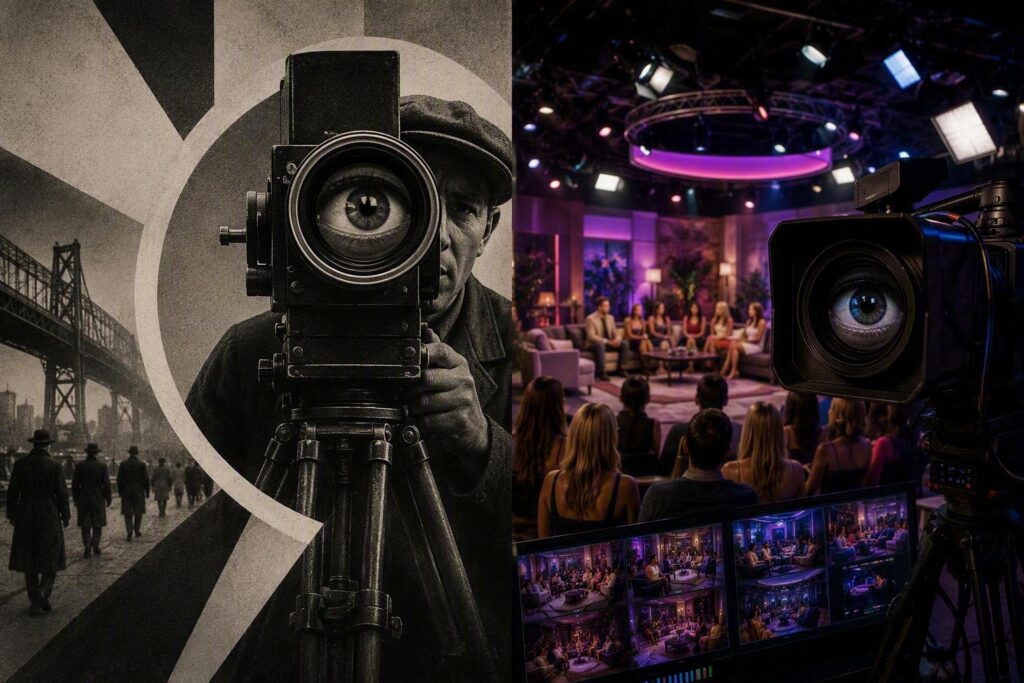
Figure 1. Juxtaposition of Dziga Vertov’s Man with a Movie Camera (1929) and contemporary reality television. AI-generated image created by the author using Microsoft Copilot (2026).
Related Video:
Related Websites:
- A film about a film about itself movie review
- The Real Housewives of Moscow | The New Yorker
- Behind the Glass (TV Series) — The Movie Database (TMDB)
Reference:
Vertov, D. (Director). (1929). Man with a movie camera [Film]. VUFKU. (Original work published 1929; YouTube video uploaded by Cinematic Orchestra, November 10, 2012). www.youtube.com/watch?v=cGYZ5847FiI
Passage II
The Language of New Media
Summary:
Chapter 1 of Lev Manovich’s 2001 book The Language of New Media asks and answers a question that researchers, artists, and students at the turn of the century were grappling with: “What is New Media?” Acknowledging that something is lost when historians wait to define trends long after they have unfolded, Manovich systematically attempts to document characteristics of his current multimedia environment. The “principles” of new media that he defines are numerical representation, modularity, automation, variability, and transcoding (2001). He explains that new media “objects” can be represented by data, the order can be rearranged, and the parts can be programmed to operate independently, such as by artificial intelligence. Programmability is a key feature of new media, as is the changeable nature not only of the output but the path by which one interacts with it. Lastly, new media can be converted into other formats.
Furthermore, Manovich (2001) debunks common “myths” of his day, which are oversimplified theories of new media. These include the claim that new media is just “digitizing” analog content. He also explores interactivity, explaining that it’s much more than just describing an interface; it’s embedded in the very nature of human-computer interaction. He springboards into discussions about how new media is informed by psychology, literature, Futurism, and Dadaism. In Manovich’s analysis, cinema is considered a significant development in new media.
Moreover, in the new media landscape, the computer user, designer or developer, and the machine itself all work together to construct entirely novel meanings. Manovich (2001) claims that this has crucial cultural implications: “In summary, the computer layer and the culture layer influence each other. To use another concept from new media, we can say that they are being composited together. The result of this composite is a new computer culture – a blend of human and computer meanings, of traditional ways in which human culture modeled the world and the computer’s own means of representing it.” This creation of meaning takes on new layers of intricacy, creating ramifications for marketing, viewership, and authorship.
Response:
I remember the days of Y2K preceding this book, when at the turn of the century the world was in a frenzy. The public was attempting to make sense of the new proliferation of data, and some believed an over-reliance on computers would portend great catastrophe. People thought that computers, made to understand the figures of the 1900s, wouldn’t be able to turn the calendar and adapt to computing in 2000 and beyond. But after the new year dawned, there was no emergency. No blue screen of death. No widespread blackout or financial doomsday. Instead, change sped up, faster and faster. Onward to cell phones, social media, smart TV, and streaming services. Many of the technologies that Manovich in some way identifies or predicts came to the fore. Ironically, the author mentioned that he purposely tried to reflect more on the present and not on the future (like he said other books did).
Having worked with engineers, I am particularly struck by his spot-on examination of “production on demand” and “just in time” delivery (Manovich, 2001). Although we still haven’t reached the era where we can design a car online from our home computer and have it built in the factory and shipped to us in hours, it can (and does) happen in mere months. Simpler products ship within hours now.
Additionally, data has become a commodity, and I’ve seen this when working in fintech. Manovich saw the seeds of the explosive growth of data when considering the updatable nature of stock prices and weather information. Now, with data centers in the headlines, the issues become even more central.
Finally, while a student at Carnegie Mellon University (CMU) in the M.A. in Professional Writing program, I studied information architecture. Thus, I am interested in Manovich’s discussion of navigating through interfaces, information retrieval and storage, and design. CMU is known for its human-computer interaction (HCI) research, so I approach his work with a foundational understanding.
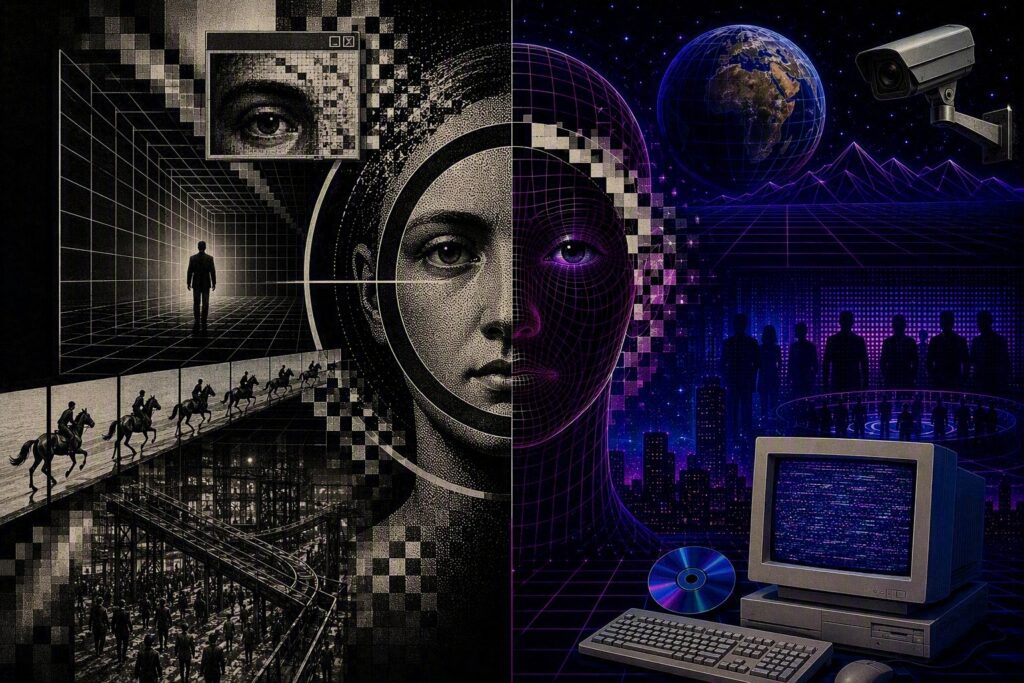
Figure 2. Visual interpretation of themes from Chapter 1 of Lev Manovich’s The Language of New Media (2001) and Y2K digital culture. AI-generated image created by the author using Microsoft Copilot (2026).
Related Video:
Related Websites:
- Y2K | Smithsonian Institution
- Information Architecture: Study Guide – NN/G
- Welcome to HCII | Human-Computer Interaction Institute
Reference:
Manovich, L. (2001). The language of new media. The MIT Press. https://mitpress.mit.edu/9780262632553/the-language-of-new-media/
Passage III
Introduction to Critical Play
Summary:
The introduction to the book Critical play: Radical game design by Mary Flanagan defines critical play as a way to reflect upon and work through life’s myriad complexities. Difficult subjects and ethical dilemmas become more approachable when placed in the context of a game: “Critical play means to create or occupy play environments and activities that represent one or more questions about human life” (Flanagan, 2009). These questions might be “abstract” such as “rethinking cooperation” or “concrete” like enacting scenarios from current events (Flanagan, 2009). Games may inhabit imaginary worlds, but they create real meaning for the players and delineate rules and roles that echo those in the real world.
Not only is it vital to childhood development, but critical play also reinforces and reshapes adult societal norms: “Critical play is characterized by a careful examination of social, cultural, political, or even personal themes that function as alternatives to popular play spaces” (Flanagan, 2009). The defined space of play provides a protected space for exploring novel ideas, solutions to problems, and practical strategies for problem-solving.
Besides defining the central concept of her book, Flanagan’s introduction reviews scholarly research on game scholarship (from Katie Slan and Eric Zimmerman), reaching past traditional perspectives to bring in multiple voices from diverse disciplines including art (such as Marcel Duchamp), media (such as Henry Jenkins), and anthropology (such as Brian Sutton-Smith). Through these lenses, Flanagan (2009) offers multiple definitions for the key terms “play” and “games,” also investigating the roles of technology and subversion in avant-garde game design. Finally, she briefly discusses activist games (based on social issues), design actions and design methods (like street interventions), and previews the content of each chapter of her book.
Response:
Flanagan (2009) mentions that her book is not a meant to be a chronology of gaming technology – she instead wants to focus on art, culture, and activism – yet she references the place of Atari in gaming history. This holds special meaning for me, as Atari was released when I was a little girl, and I can remember my father manning the helm of the spaceship in Asteroids, deftly destroying the moving targets.
Additionally, I have many happy memories of playing video games myself as a child. Some of my favorites were Super Mario Brothers, Legends of Zelda, Contra, and Tetris on Nintendo, and Super Mario Land on Game Boy. My brother and I would play each other, and also compete with friends and neighbors. I can still remember the thrill of reaching new levels and discovering new digital worlds, although it’s been years since I’ve held that Nintendo console. Was my play critical or purely fun? I’d say both. Certainly the games led to improved hand-eye coordination and dexterity, technical knowledge, and cultural fluency.
It’s also worth noting that beyond the visuals, the audio tracks continue to hold cultural weight. For example, just this month Nintendo announced that it’s releasing a Legends of Zelda soundtrack on vinyl with Laced Records. There is also a Nintendo Music app, where streamers can listen to video game music from yesteryear.
Games remain an important part of my family’s lifestyle. My mother loves Word games and card games; she founded a Scrabble club and also enjoys in-person bridge games with other active seniors. Gaming is a social experience for her, and a chance to employ both logic and strategy. Online, also plays Words with Friends as a way to keep her mind active and stay connected with friends and family members.
However, in investigating the many different functions of gaming, including critical play, social activism, creative outlets, and artistic expression, one should also consider that there can be pitfalls to spending too much time in an alternative reality. While gaming in moderation can develop artistic skill, coordination, and socialization, if it is used excessively as an escape from reality or even a coping mechanism it can lead to unhealthy addictions.
From a literary perspective, Flanagan’s introduction (2009) reminded me of two compelling novels that tackle themes at the intersection of gaming, digital escapism, and the role of media and technology: Tomorrow, and Tomorrow, and Tomorrow by Gabrielle Zevin, and The Nix by Nathan Hill. In addition to books covering these concepts, a plethora of movies feature related ideas. For example, Electric State and Bliss examine the dangers of isolation or addiction at the expense of health and relationships. On the lighter side is the imaginative A Minecraft Movie, which depicts gaming as a fun, collaborative team sport.
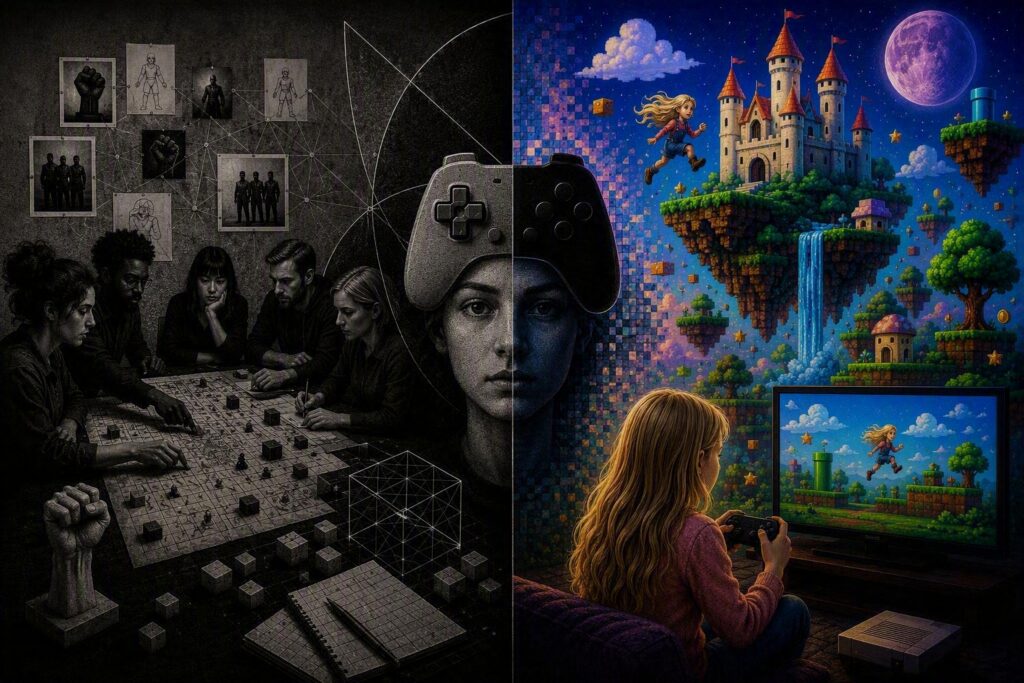
Figure 3. Visual comparison of concepts from Mary Flanagan’s Critical Play: Radical Game Design (2009) and mainstream platform gaming culture. AI-generated image created by the author using Microsoft Copilot (2026).
Related Video:
Related Websites:
- Tomorrow, and Tomorrow, and Tomorrow – Gabrielle Zevin
- The Nix – Nathan Hill
- Nintendo and Laced Records – The Legend of Zelda: Breath of the Wild vinyl soundtrack collection available today! – News – Nintendo Official Site
Reference:
Flanagan, M. (2009). Critical play: Radical game design. MIT Press.
Passage IV
Playing House
Summary:
The second chapter of Mary Flanagan’s book Critical play: Radical game design is titled “Playing House.” In this chapter Flanagan (2009) claims that play in domestic spaces has both reflected and subverted cultural values. For example, doll play in the Victorian era reinforced gender stereotypes that tied women to roles as daughters, wives, and mothers, yet in the wake of world wars artists exhibited mutilated dolls to shed light on the atrocities of battle. Meanwhile, as both leisure time and the characterization of childhood expanded to encompass room for play, playtime became an entrenched cultural norm. It also became part of industrialized consumer culture, with toymaking shifting from the home enterprises of women to mass factory production led by men. Later, computer games like Sims, while cloaked in the digitization and pixels of new technology, mimicked the same “feminization” of space as traditional doll play. The game may take place on the computer, but it centers around the household space. Furthermore, one of the goals of the game is to maintain the household and keep the family happy.
Flanagan (2009) explained that as the suburbs grew in popularity and dangers of the city and terrorists threats mounted, the suburban home became idealized as a utopian space: “In using the house and its immediate surroundings as a normative palette with which to create their own image of home and household relationships, game designers reinforce, though perhaps with a degree of self-awareness and irony, previously established ideas about domestic utopias, including those put forward by advertising and corporate marketing research.” In her analysis, the house and its yard became the center of the action for games like Sims. Game play provides a pathway to realize the American Dream of homeownership. Here players can customize their homes and yards with furnishings of their choice, and in this virtual democracy everyone starts out with the same options. Players must find ways to gain income to pay for their appliances, and the kitchen is the center of the home.
Response:
Flanagan’s research (2009) incorporates psychiatry (Sigmund Freud) and philosophy (Michel Foucault) among other viewpoints. She writes that in the past children and adults shared the same games, until childhood became a recognized period in development. Household norms are introduced in our childhood play as children learn to navigate in the realm of adults.
When my father, now a retired psychiatrist, was in school, child development expert Fred Rogers was one of his professors. You may have heard of Mister Roger’s, as his neighborhood is famous among children who grew up in the 80s like me. My first record was probably a compilation of his songs, and I watched Mister Rogers’ Neighborhood when I was a little girl. In fact, I grew up in Western Pennsylvania, less than a few hours drive from his television studio in Pittsburgh.
Mister Rodger’s show was delightful to watch. Puppets, castles, and a trolley made up his world of “make-believe,” and scenes with fanciful characters like Lady Elaine Fairchilde and the King Friday XIII taught children like me about social structure, authority, handling conflict, and the benefits of belonging to a greater community.
In addition, I spent time playing the games that most little girls played, including dolls (Barbie and Cabbage Patch Kids) and house, which Flanagan notes plays a role in socializing children. It’s interesting to think of these popular games as critical play, and to consider them the context of ritual.
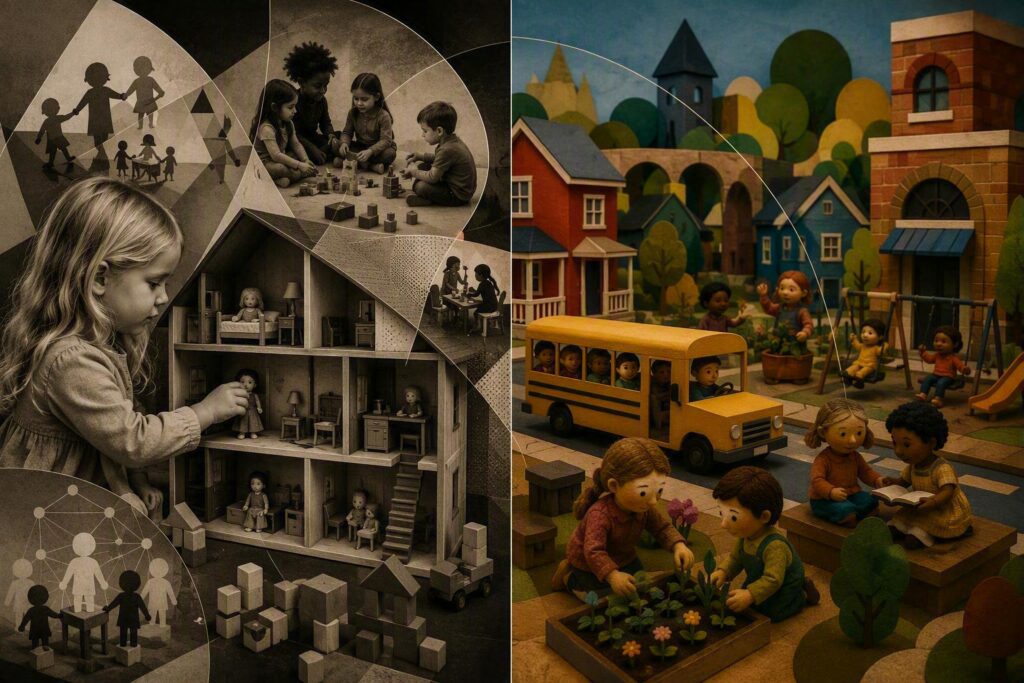
Figure 4. Visual interpretation of themes from Mary Flanagan’s “Playing House” chapter, emphasizing imaginative play, dollhouses, community learning, and educational neighborhood environments. AI-generated image created by the author using Microsoft Copilot (2026).
Related Video:
Related Websites:
- Homepage – Mister Rogers’ Neighborhood
- Inside the Barbie Dreamhouse, a Fuchsia Fantasy Inspired by Palm Springs | Architectural Digest
- The Sims
Reference:
Flanagan, M. (2009). Critical play: Radical game design. MIT Press.
Note: All figures and their captions were created by the author using Microsoft Copilot and were designed as original interpretations of course concepts for educational purposes.