Passage V
Language Games
Summary:
“Language Games,” the third chapter of Mary Flanagan’s book Critical play: Radical game design, explores the unique capacity of “wordplay” to create meaning that can both reflect and challenge cultural conventions, causing players to reconstruct their vocabularies and hence, their world views, in novel ways. Flanagan (2009) sweeps across the 19th, 20th, and early 21st centuries surveying the practices artists use to build play spaces, subvert language, tap into the subconscious, and critique societal norms. She reviews a variety of writers and artists that use language in innovative ways, including Edgar Allan Poe’s use of palindrome’s (word puzzles) and the puppets and puns that Alfred Jarry staged to poke fun at the bourgeois and launch the Theater of the Absurd. Marcel Duchamp and Man Ray’s Anemic Cinema buck convention with their own puns and wit, filming spinning disks etched with cryptic writing. Guillaume Apollinaire names a new movement called “Simultanism;” his graphic poems mix up words to uncover “surprise,” stimulating other famous avant-garde groups such as Dadaism and Surrealism.
Flanagan (2009) also examines the techniques behind the language games. Unconcerned with traditional punctuation and grammar, the Surrealists adopted non-stop “automated drawing and writing” to find new ways to comprehend the self and make sense of a war-torn world. Fluxus painters like Yoko Ono produced cards with instructions meant to turn passive spectators into active participants in the process of art making. Such instillations redefined not only what art could be (not just expensive paintings but even everyday objects), who could make it (anyone), and where one could find it (anywhere). Language becomes a tool and weapon, as costumes and canvas combine with poems and slogans to “reskin” old ways. Seizing on the opportunity for change, the Guerilla Girls wielded words as weapons in their art, targeting sexism in New York’s galleries. More recently, words and text are linked in interactive presentations such as poetry projected on buildings, captured in video, and reimagined by participant movement.
Response:
Trained as a writer, I found this chapter interesting in two main ways. First, it explores issue of authorship and agency in writing and art, and looks at how text and images can combine to create meaning. Recognizing that words do not appear in isolation but are taken in context with other media, communications design was a part of the coursework that I studied as a student at Carnegie Mellon University (CMU) in the M.A. in Professional Writing program. There, one of the underlying themes of faculty research was the visual-verbal connection. Different types of content work together for distinct rhetorical purposes, and the way in which visual and verbal elements are combined helps us navigate interfaces. Similar to Flanagan’s (2009) look at language games, research into the visual-verbal interplay incorporates multidisciplinary perspectives from rhetoric, communications, and graphic design, psychology, linguistics, and human-computer interaction. Linked below are two pieces that delve into this work.
Second, beyond the usability of content, we can look at its playfulness. Like Flanagan (2009) wrote, this can encompass language’s potential to entertain, engage, and question our assumptions. As a child, I played games that showed me how language can surprise us in unexpected ways. One such game was telephone, where the players sit in a circle. The first player makes up a phrase and whispers it to another person, and they in turn whisper it to another, until all the players have gone. The final player says the phrase aloud, often finding it is hilariously different than what the first player said. Another popular game I played was Mad Libs. Here, stories are written down with key words missing. Players must fill in the parts of speech (nouns, adjectives, etc.) without knowing the context of the story. The result can range from nonsensical, to funny, to surprisingly realistic. Games like telephone and Mad Libs are effective because they both rely on and challenge the predicable structure of language.
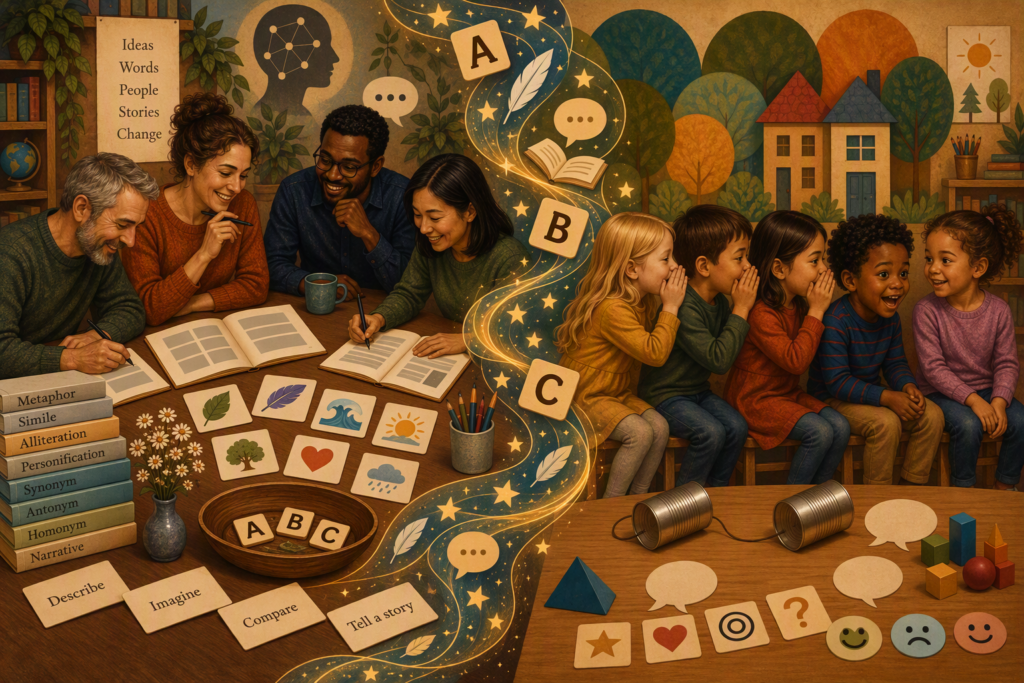
Figure 1. Visual of meaning-making and message transmission comparing topics from Mary Flanagan’s “Language Games” chapter and the telephone game. AI-generated image created by the author using Microsoft Copilot (2026).
Related Video:
Related Websites:
- (PDF) Collaborative argument across the visual‐verbal interface
- Visual/Verbal Meaning Collaboration in Redefining Interplay
- Home – Mad Libs
Reference:
Flanagan, M. (2009). Critical play: Radical game design. MIT Press.
Passage VI
Performative Games and Objects
Summary:
In “Performative Games and Objects,” the third chapter of Mary Flanagan’s book Critical play: Radical game design, acting takes center stage. Flanagan (2009) answers many questions in this chapter, including: What are performative games? Who designs and performs them? What movements have influenced them? Where can they take place?
Flanagan (2009) begins by defining performative games as “games that achieve critical play through a significant sense of performance in their attempt to influence society, or to provide utopian and playful visions and revisions of the world.” Similar to theater, these games include an audience, actors, and scenes that are played out. The games are in part created by game designers and artists, but for play to take shape, the players must join in the world creation. Play can take place in a variety of locales: one might play a “parlor game” infused with “historical” discussion at home, a chess game with “human-sized” pieces at a festival, or a mixed-modal game bridging online and in-person action in the big city.
The diversity of performative games extends from location to artistic movements. Several avant-garde styles have influenced performative game play, including Dada and Surrealism in Europe, Gutai in Asia, and Fluxus in North America (Flanagan, 2009).
The profile of performative gaming is heightened when a city is inswept in the game, and non-players can become participants. Flanagan (2009) explains that the game itself becomes both a spectacle and creative construct: “By calling attention to the pleasure of everyday play, the construction of rules, and the very logic behind games, a shift in consciousness is required for most of the public to perceive action as art.”
Key to Flanagan’s analysis of performative games is the deeper purpose that can be uncovered in the conventions, rules, and objects of game play that lead to thoughtful interactions between participants. As the players are world builders, their actions can be both playful and critical, creating new rules and advocating for change.
Response:
Why are art and performance created? Is it for entertainment, beauty, expression, or social change? Mary Flanagan (2009) believes that performative games can fulfill all of these functions, and more. Flanagan teaches us that there can be much subtext to read between the lines of performative games. They redefine what play (and a play) can be about, what it can look like, and how it can end. Writing a new play book on what performance could be can change our views on art.
In a similar vein, performative games don’t have to be fancy. They can include freeze tag in a yard and charades in the living room, as well as larger shows in lavish theaters. Both live and on television I’ve seen how improvisational acting can reflect cultural themes, sometimes in an ironic light, echoing the earlier modalities of the Theater of the Absurd, Fluxus, and Flarf poets. In improv, everyday scenes are spotlighted instead of a story that wraps up in a bow, dialogue is stitched together on the fly, and the action itself becomes the attraction, not the resolution.
Improv games might have fluid rules that depend on the actor’s and audience’s choices. Often the themes and direction is led by votes of the audience subverting the traditional writer/director paradigm. Audience members themselves may become the actors, just as in Flanagan’s analysis spectators can become artists and players.
Likewise, television game shows provide spectacle as contestants play for prizes. Players can be recruited from the audience and often viewers at home play along. The shows are a game, a performance, and a pop-culture phenomena. As Flanagan (2009) concludes: “Finally, as a form of critical play, performance elevates the role of the player and the aura of artworks shifts to the public.”
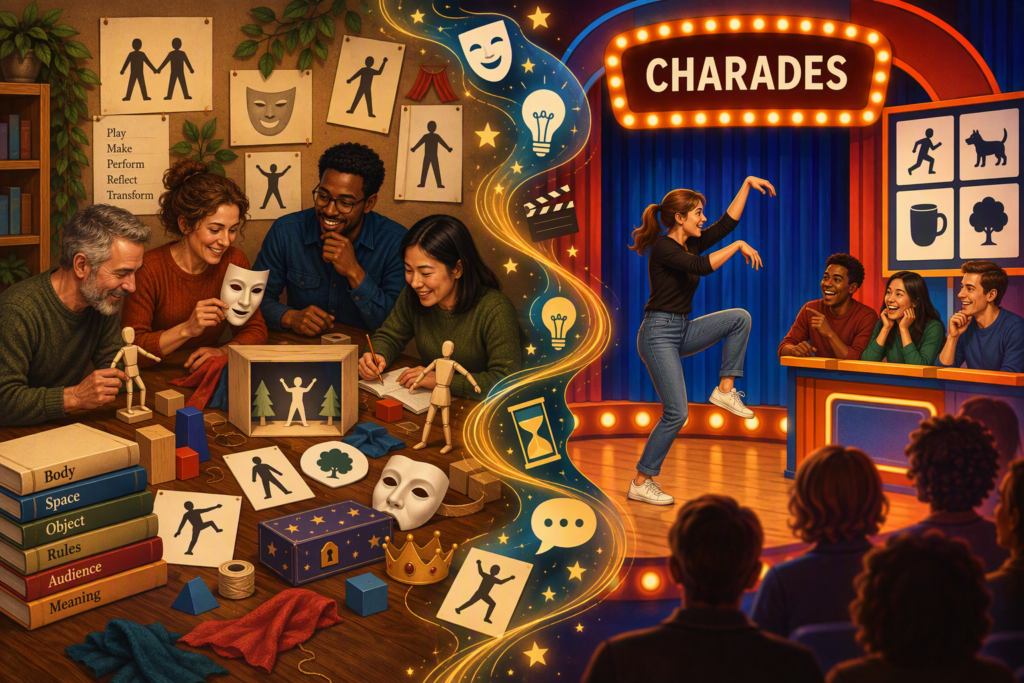
Figure 2. Visual rendering of themes from Mary Flanagan’s “Performative games and objects” chapter compared with charades as performative play. AI-generated image created by the author using Microsoft Copilot (2026).
Related Video:
Related Websites:
- Improv Encyclopedia
- Game Shows | Programs | Pioneers of Television | PBS
- What Happens When Kids Design Playgrounds? Lava, Mushrooms, Giant Chess. – The New York Times
Reference:
Flanagan, M. (2009). Critical play: Radical game design. MIT Press.
Passage VII
eXistenZ
Summary:
The 1999 movie eXistenZ by filmmaker David Cronenberg projects many of the themes in the minds of new media scholars, including navigating identity in an emerging digital world, distinguishing between play and reality, and forging your own place in a changing society. In eXistenZ, we are introduced to Allegra Gellar, a female game designer fighting for her life and career in a male dominated industry. Allegra has built a revolutionary game that runs on living animal pods that literally plug into the human backbone. The game sucks people into a virtual reality, giving them a whole new world in which to play. This holds immense appeal to those looking to escape ordinary life. But it has also made her the target for Realist activists who don’t approve of the digital playground and have infected her game.
When her assassination attempt is thwarted, she is thrust into the hands of a man she doesn’t even know, Ted Pikul, a marketer in training who unwittingly becomes her bodyguard joining her inside her game in an attempt to diagnose the illness and root out her enemies. Ted is unhappy to find that in the game the characters lose agency over what they say and do. It’s later unveiled that how they speak – with what type of and level of accent – isn’t always their choice either.
While the movie includes all of the usual trappings of a Hollywood script (chase scenes, romance, and a “who-dunnit” mystery), audience goers are led to believe one thing (that Allegra’s in charge) when another is true (she’s not on the run, she’s really the killer).
Thus, in the end it is revealed that Allegra wasn’t a target at all. She was a player in a man’s game all along. She and Ted already knew each other the whole time, and they are secretly subversive forces who want to unplug the “real” gaming hierarchy. They are, in fact, the Realists that they had been running from. To top it all off, Ted’s American accent was also fake. He’s actually British.
After they shoot the “real” game designer, Allegra and Ted turn on one of their own teammates. Have they blurred the line so much they will murder an innocent? The movie ends with that question and many more: Who are the good guys? Is all technology progress? Who is the boss? Who is in control? What are the rules? And last but not least, who won?
Response:
Released in the shadows of The Matrix blockbuster, I saw the first movie but don’t even remember hearing about eXistenZ when it first came out. However, I can see several similarities between the two films, and after researching the topic, I found that I’m not alone. There are many articles that point out the striking similarities. Characters find themselves in another reality. They don’t know what’s real. They don’t know who to trust. Their world view is subverted. Digital chaos ensues.
Furthermore, eXistenZ flips the script of an earlier film, The Bodyguard, in which a highly-trained agent guards a beautiful star. In eXistenZ, the bodyguard is thrust into his role with no training at all. Regardless of if it was meant as a parody of that film, eXistenZ does portray poor Ted in a stronger light when he’s in the game.
eXistenZ is ripe with metaphors. There’s the two-headed creature that is a “sign of the times” as both food and fuel for gaming, and a gas station where you can recharge your car and your game pod. With the games’ plot twists and turns, the characters have trouble distinguishing between play and real life. Filmmaker David Cronenberg leaves some of the lines as blurry, giving us much food for thought, whether or not we can stomach eating the amphibians he serves up.
Meanwhile, virtual reality and augmented reality are no longer science fiction. There is a website describing virtual reality experiences at Florida Atlantic University. The headsets are used for tutoring for anatomy and physiology. Of course, there are games to try, as well. No organic pods needed!
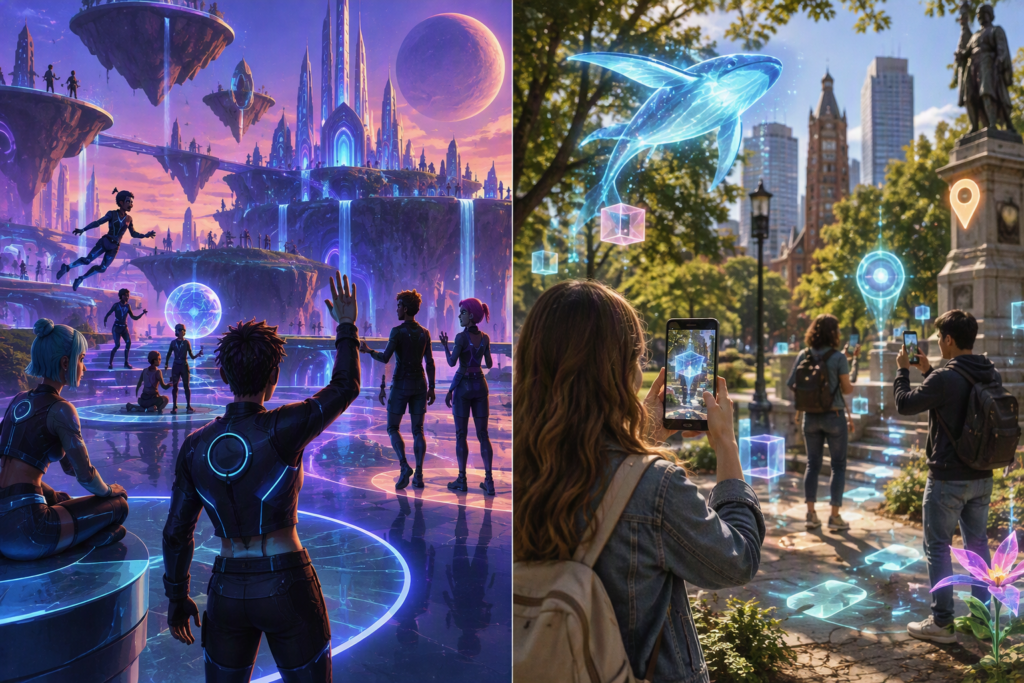
Figure 3. Virtual worlds and augmented reality play. AI-generated image created by the author using Microsoft Copilot (2026).
Related Video:
Related Websites:
- David Cronenberg’s eXistenZ Is the Sci-Fi Film The Matrix Overshadowed
- The Bodyguard (1992) – IMDb
- Virtual Reality Experiences | Florida Atlantic University
Reference:
Cronenberg, D. (Director). (1999). EXistenZ [Film]. Dimension Films; Alliance Atlantis
Passage VIII
Psychogeography
Summary:
In the article “Psychogeography: A Purposeful Drift Through the City” artist and professor Karen O’Rourke (2021) explores the concept of psychogeography as more than a strict amalgam of the words “psyche (breath)”, “earth (geos)”, and “graphein (to write).” Instead, it is a way to “carve” meaning in “urban space” in unexpected ways, through unexpected routes, with unexpected emotions.
The oxymoron “purposeful drift” refers to a subversion of the bustling city in which inhabitants travel with intent directly from point A to their destination at point B (O’Rourke, 2021). Instead, they forge a different type of route, one that might meander off the beaten path, choosing to lose themselves in the action of the crowd or the curvature of the sidewalk. In 1950s Paris, this “mapping” of the city was seen as a type of “parlor game” — a playful reimagining of public spaces. Letterist International artists dubbed it “Psychogeography,” but it wasn’t a movement without roots.
About a century prior, “the figure of the flâneur” emerged as Edgar Allan Poe’s story “The Man of the Crowd” and Charles Baudelaire’s essay, “The Painter of Modern Life” portrayed men who had the luxury of spending their days zig-zagging through the city streets in search of chance meetings (O’Rourke, 2021). Letterist International took this a step further. Beyond walking, they used cars to either study the city of lose themselves in it. This way of “remaking the world” was also a means to reawaken emotions that had been lost in transit, finding new ways to breathe life into familiar crowds.
Response:
Reclaiming city space in an innovative way – or simply finding alternative routes to experience the land that is already beneath your feet – is an idea that has long captivated me. When I lived in Pittsburgh I trekked through the city on urban hikes. These walks, still held today, joined participants in exploring district neighborhoods, architecture, and terrain. Each hike was a way of reclaiming the history of the place in a city that had to redefine itself after the steel boom ended.
Similariy, I had a colleague who enjoyed another contemporary way of using leisure time to explore the city: geocaching. Players in this game followed GIS coordinates to find geocaches hidden by others in their community. These caches included a log book to sign and mementos left by other players. Each cache could become a time capsule, a way to preserve a memory that could later be opened and reflected upon. It’s a modern-day treasure hunt.
More recently, as part of a seminar class “The City: Aesthetics and Politics” with Richard Shusterman, I’ve been reading the words of Poe and Baudelaire, as well as listening to professor Shusterman’s podcast. The atmospheres podcast was recorded at Florida Atlantic University during the Center for Body, Mind, and Culture’s “Somaesthetics of Atmosphere” conference in 2024. The series features interviews with scholars about the distinct climates and characteristics of their home cities. Each episode investigates the influence of a cityscape throughout various time periods, seasons, and times of day. From religion, to mood, to leisure many aspects of the city are discussed.

Figure 4. Depiction of psychogeography and geocaching. AI-generated image created by the author using Microsoft Copilot (2026).
Related Video:
Related Websites:
- Urban Hike
- atmospheres Archives – The Center for Cosmopolitan Culture
- Center for Body, Mind, and Culture | Florida Atlantic University
Reference:
O’Rourke, K. (2021, July 16). Psychogeography: A purposeful drift through the city. The MIT Press Reader. https://thereader.mitpress.mit.edu/psychogeography-a-purposeful-drift-through-the-city/
Note: All figures and their captions were created by the author using Microsoft Copilot and were designed as original interpretations of course concepts for educational purposes.